

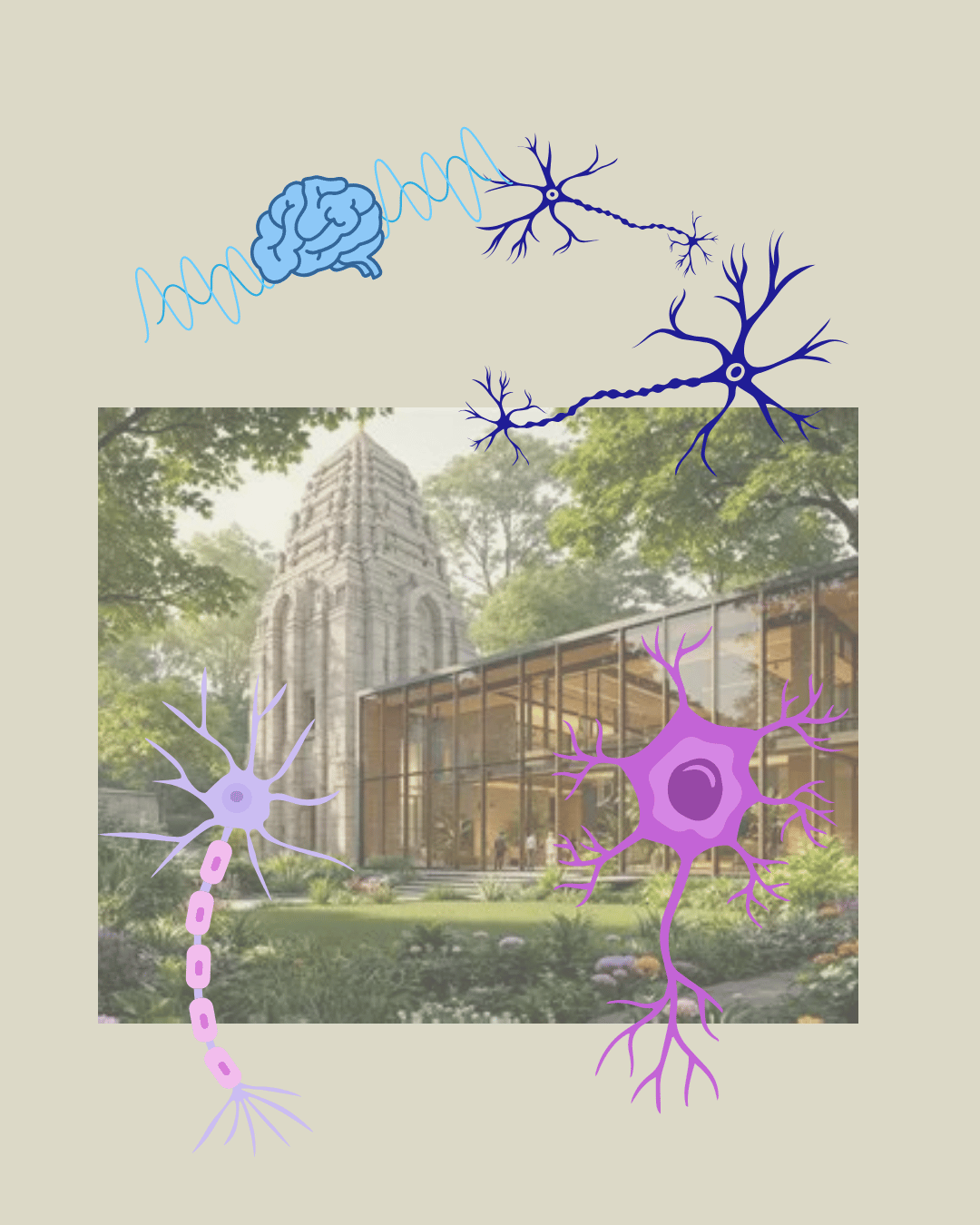
The Nervous System & Architecture
I saw a post recently about how architecture has become dull and drab compared with what humans used to create, and it made me think about something I see everywhere now: our nervous system state shapes what we build, wear, buy, tolerate, and call beautiful. I created The Nervous System Wardrobe because I realised our clothes are not just aesthetic choices. They are often survival strategies. We dress for protection, visibility, invisibility, comfort, control, belonging, or expression, depending on the state we are living from, and they actually change the way we behave.
The following is not a strict historical rule, but a lens. When we look at architecture through the lens of the collective nervous system, we start to see how safety, threat, power, beauty, scarcity, and overstimulation shape what we build.
Our internal world becomes our external world, as evidenced throughout our history. One way to read human history is as a nervous-system diary written in stone, fabric, colour, architecture, music, and culture. When we collectively feel safe, connected, regulated, and grounded, we create beauty, ornament, craftsmanship, colour, ritual, meaning, and coherence. When we collectively feel overwhelmed, disconnected, traumatised, or in survival mode, we create minimalism, concrete, speed, efficiency, beige that turned to grey, sameness, noise and distraction. This pattern repeats through every century, every civilisation and every cultural shift.
The Nervous System Through the Ages: How Each Era Built Its Internal State Into Its Architecture
Prehistoric & Neolithic (10,000–3,000 BCE)
The collective nervous system was grounded, communal, land-connected, survival-focused, but regulated through tribe and nature. The architecture featured earth-built homes, caves, stone circles, communal longhouses, and structures aligned with the seasons, the stars, and rituals. Humans lived close to land, animals, the seasons, and each other. Safety came from connection, not walls. The architecture was simple but spiritually meaningful; a collective nervous system regulated by nature itself. This is the earliest evidence that internal coherence equals external coherence.
Ancient Civilisations (Egypt, Mesopotamia, Greece, Rome)
From a nervous-system lens, this era was stable, hierarchical, ritualised, and identity-rich. The architecture featured temples, pyramids, columns, symmetry, ornament, carved mythologies and geometric precision. These societies had enough surplus regulation to create beauty. They weren’t firefighting their existence daily; they were building meaning. Architecture became a way to express cosmic order, divine connection, and cultural identity. This is the era of regulated beauty.
Medieval & Gothic (12th–16th century)
The collective nervous system was anchored in fear, existential anxiety, religious dominance, and plague trauma. The architecture featured towering cathedrals, pointed arches, stained glass, ribbed vaults, ornate facades and verticality. People were living with death, disease, and religious fear, so the collective nervous system was in chronic threat physiology. Architecture reached upward, seeking safety in the divine. Gothic architecture is fear expressed as height, light, and symbolism. To me, this is also where emotional sovereignty becomes an interesting question. When people live in fear and survival mode (like now), they often become more vulnerable to external authority. In that sense, Gothic architecture can be read not only as devotion but also as a culture seeking safety outside itself.
Renaissance (14th–17th century)
The emotional imprint of this era seems to be one of intellectual awakening, curiosity, and the return of stability. The architecture was built in proportion, harmony, and symmetry, with domes, mathematical beauty, and a human-centred design. The collective nervous system shifted from fear to exploration. Beauty became a way to express human potential, balance, and order. This is parasympathetic creativity; people felt calm enough to innovate.
Baroque & Rococo (17th–18th century)
The collective nervous system went into overstimulation, power, indulgence, and emotional intensity. The architecture featured gold, curves, drama, maximalism, theatricality, and sensuality. During this era, monarchies and elites used spectacle to assert dominance, which never changed. The collective nervous system swung into sympathetic activation, stimulation, emotion, and excess. This was dopamine architecture.
Industrial Revolution (18th–19th century)
The architecture tells a story of overstimulation, much as it is now; back then, it was due to crowding, pollution, and labour trauma. The architecture saw factories, slums, cramped housing, and ironwork. People lived in sensory overload and economic pressure. Victorian interiors became overstuffed, a psychological buffer against chaos. However, plants were introduced into the homes, so they got one thing right. This was overwhelm architecture. We do this personally too. When we are overwhelmed, we choose clothes, colours, and routines that help us cope.
Post-War Era (1945–1970)
The built environment reflected a recovery from trauma, marked by a state of freeze, scarcity, and rebuilding. The architecture consisted of concrete blocks, minimal ornament, prefab housing and uniform estates. The world was in shock; beauty requires surplus nervous-system regulation, and nobody had any; as a result, the architecture became functional, heavy, blunt. This is trauma architecture.
The 1980s
I had to mention the 80s: Culturally, this period was marked by a state of activation, chaos, novelty, and stimulation brought on by the rise of technology. The architecture and design were neon, Memphis design, shopping centres and malls, glass blocks, geometric patterns, and everything was made of plastic. This is where we started disconnecting from nature in a big way and moving into consumerism. We were a civilisation coming out of freeze overshot into stimulation. It was manic, colourful, loud, and it was sympathetic activation disguised as fun. This was manic architecture.
The 1990s–2000s
The emotional imprint of this era seems collapsed, dissociated, and emotionally shut down. The architecture began to shift toward minimalism, clean lines, a tech aesthetic, sleek surfaces, and monochrome palettes. After the overstimulation of the 80's, the collective nervous system withdrew. Design became cold, efficient, emotionless. This is dissociation architecture; during this time, most people were not connected to the land in the slightest.
The 2010s–2020s
The collective nervous system became burned out and overwhelmed, entering digital fatigue. The architecture reflected it through beige and grey interiors, soft minimalism, sensory-safe spaces, biophilic design, and neutral palettes. People were beginning to crave regulation. Beige and grey were not a trend; they were a coping mechanism. This was the collective nervous system in the stage of triage architecture.
The Great Awakening (2024–2026)
The collective nervous system said it had had enough and began reaching for restoration, reconnection, grounding, and meaning-making. Our culture is changing; many are creating community spaces and returning to homesteading, herbalism, spirituality, connection to the land, and off-grid living. The collective nervous system is trying to return to regulating environments. People are rejecting overstimulation and are seeking coherence. This is parasympathetic restoration: the collective nervous system healing itself through nature, community, and meaning.
So maybe now we are at this stage, and AI is going to give us the opportunity not to be stuck in offices with harsh lighting and office politics. Our architecture may start to become beautiful again, incorporating nature; it's already begun with living walls, organic materials, and environments that regulate rather than deplete.
I really enjoyed writing this anyway. I'm going to leave you with this: “When a person is overwhelmed, they create to survive. When a culture is overwhelmed, it stops creating beauty because it’s trying to survive.”
If your wardrobe, home, or daily environment feels like it is built around coping rather than expressing who you are, start with understanding survival mode. I’ve created a free resource to help you recognise the signs and begin regulating from the inside out. It's here; it's free.
Muchos love x